
Every year, European industry generates enormous volumes of waste and by-products (biomass residues, mineral wastes, effluents, off-cuts, spent materials) that too often end up underused, landfilled, or simply burned. At the same time, industries across the board still extract enormous quantities of raw material and are under growing pressure to reduce their carbon footprint and to source materials closer to home. The bottleneck has rarely been a shortage of resources; it has been the absence of a reliable way to understand where these resources actually are, who holds them, and who could use them.
That is the gap Synergy Builder was built to close.
A living map of industrial Europe
Synergy Builder, developed by the French SME Seitiss, is a platform for industrial symbiosis at European scale, cross-referencing public and internal data: it brings together industrial and agricultural establishments across Europe on a single interactive map ; cross-references their activities and material flows (waste, raw materials, effluents) and helps identify the partners best positioned to valorise them. Instead of manually chasing down waste registries, calling suppliers, or relying on word of mouth, teams can query the whole industrial landscape in a few clicks.
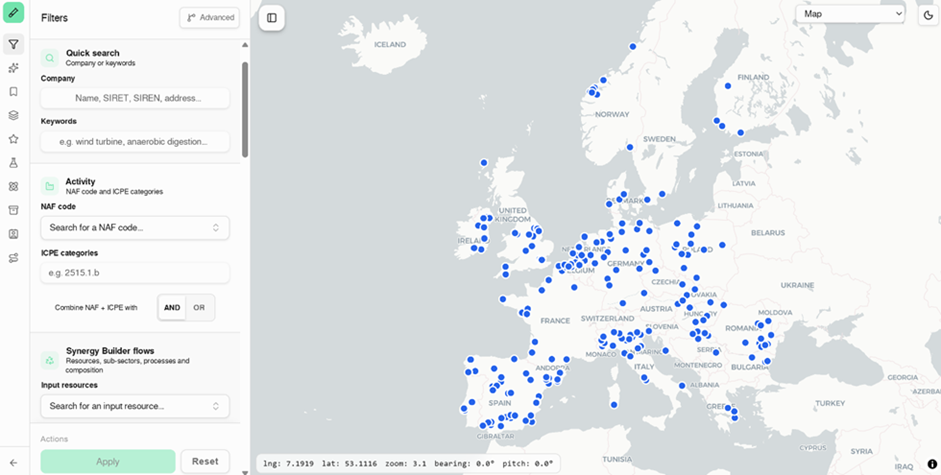
The platform is built to identify circularity loops and address the lack of reliable data on material flows in circulation. It includes:
- Interactive mapping of establishments across Europe, with advanced filters by activity, waste and material type, process, etc.
- Detailed site profiles combining official data with known material flows
- Synergy detection, matching potential emitters and users of a given material or waste stream
- Territory analysis, for assessing regional availability and concentration of specific resources
- Logistics routing, to weigh transport distance and feasibility between potential partners
Built for the biomass-to-building-materials value chain
Sourcing biomass residues for construction materials raises a specific version of this problem: the volumes, the seasonality, and the geographic spread of agricultural and forestry residues which vary enormously from one region to the next, and a manufacturing plant is only viable if it can secure a stable, cost-effective supply within a reasonable radius.
This is precisely the use case Synergy Builder is being applied to within CIRCBUILT, tackling the first link in the circularity chain for bio-based construction materials .
Within CIRCBUILT, Synergy Builder is used to source and map several secondary raw material (SMR) streams (rich in cellulose and lignin) across Europe and to identify the zones with the highest production potential. The SMR that have been assessed are the following:
- Wheat straw
- Soybean hulls, from soybean oil and meal processors
- Buckwheat hulls, from buckwheat hulling and processing facilities
- Flax shives (« anas de lin »), from flax scutching mills
- Rapeseed straw
- Barley straw
- Conifer bark
- European Larch bark
- Scots pine bark
By cross-referencing where each of these co-products is generated, in what volume, and how far they would need to travel, Synergy Builder points toward the locations where a new production site would have the strongest, most resilient supply chain from day one.
Why it matters
For manufacturers, developers, and public agencies working on circular construction materials, the question is rarely « does a viable resource exist somewhere in Europe? » It almost always does. The real question is where, how much, how reliably, and who else is already competing for it. Synergy Builder turns that question from a months-long feasibility study into a workflow giving industrial symbiosis, circular economy, and site-selection teams a shared, data-backed view of the regional material flows, so they can move from resource to roadmap much faster.
Want to see how Synergy Builder could map your own supply chain? Take a look at the tool’s homepage , and our brief tutorial or get in touch with Seitiss (it@seitiss.com) to request a walkthrough.

Antoine Claveau is a Circular Economy Engineer at SEITISS. He specializes in developing tools and methodologies that foster resource efficiency and industrial symbiosis. Antoine led the development of the Synergy Builder tool with his team, supporting stakeholders in identifying circular economy opportunities and creating sustainable value from resource synergies.


