
Can Agricultural and Wood Residues Keep Buildings Warm and Quiet?
Buildings need insulation to remain comfortable, energy-efficient and quiet. Today, many insulation products are made from fossil-based plastics or mineral materials. They provide reliable performance, but their production depends largely on non-renewable resources and may create challenges for recycling and end-of-life treatment. Plant fibres offer a promising alternative. Residues from agriculture, forestry and other industries can potentially be transformed into lightweight structures that trap air. This porous structure can slow heat transfer and absorb sound. However, bio-based insulation still faces important challenges, including moisture sensitivity, fire safety and mechanical strength. The CIRCBUILT project is exploring how foam-forming technology and bio-based additives could help overcome these limitations.
What is a bio-based fibre foam?
A bio-based fibre foam is a lightweight, porous material produced from plant-based fibres, water and air. During foam forming, air bubbles help distribute the fibres evenly and create an open three-dimensional structure. After water removal and drying, numerous small air spaces remain inside the material.
These air spaces are important for the material’s performance. Trapped air can slow down heat transfer, while the porous fibre network can help absorb sound. By adjusting the raw materials, density, thickness and internal structure, fibre foams can therefore be designed for applications such as thermal insulation in walls and roofs or acoustic panels for indoor spaces.
Unlike conventional plastic foams, the foam used during manufacturing is mainly a processing tool. The final product is a solid network of fibres rather than a mass of permanent bubbles.
Turning secondary resources into useful materials
CIRCBUILT focuses on secondary bio-based resources rather than materials cultivated specifically for producing insulation. Candidate raw materials include agricultural residues and side streams from wood processing, such as wheat straw, flax-based materials and wood chips.
These resources contain lignocellulosic fibres that can potentially be processed into lightweight panels. Using existing material streams could reduce dependence on virgin and fossil-based raw materials while creating higher-value applications for materials that might otherwise be used for lower-value purposes. However, using secondary materials also presents challenges. Their properties can vary according to their origin and previous processing. The fibres must therefore be carefully selected, prepared and characterised to ensure that they are suitable for foam forming and can provide consistent performance in the final product.
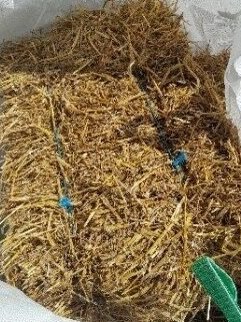
Wheat straw is one of the agricultural residues considered as a secondary bio-based raw material for fibre-foam development
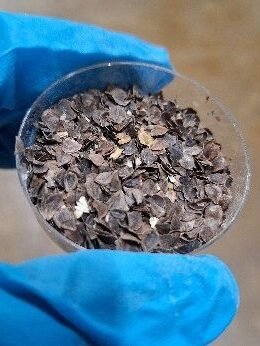
Buckwheat hulls are another example of an agricultural side stream that may be explored as a lightweight bio-based material resource.
The CIRCBUILT approach for foam forming
The CIRCBUILT project combines the selection of secondary fibres, foam-forming technology and bio-based functional additives. The aim is to develop lightweight materials that can be used as the basis for both thermal insulation panels and indoor acoustic panels.
VTT is developing foam-formed structures for thermal insulation and studying how their production can be scaled up. INRAE is investigating a surfactant-free foam-forming approach, while AISTI is developing functional acoustic panels for indoor applications. The partners are also examining how bio-based fire-retardant solutions can be integrated into the materials without losing the lightweight and porous structure needed for insulation and sound absorption.
The same basic foam-forming principle can be adapted for different applications. A thermal insulation panel should limit heat transfer while maintaining sufficient mechanical stability. An acoustic panel, in contrast, should have a structure that allows sound waves to enter the material and dissipate within its porous fibre network. Material density, thickness, fibre type and other formulation parameters must therefore be adjusted according to the intended application.
From fibres to panels
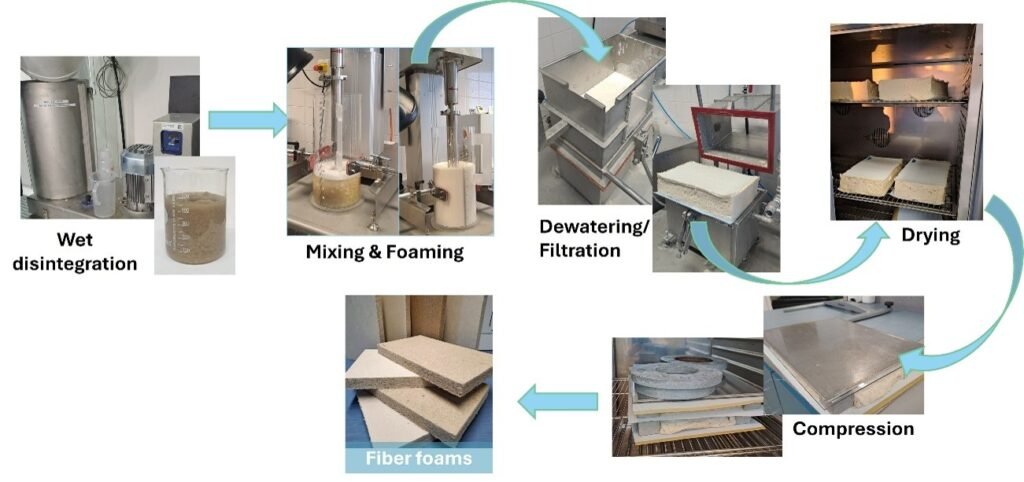
The production process begins with the selection and preparation of suitable secondary bio-based raw materials. The materials are processed into fibres with characteristics appropriate for foam forming.
The prepared fibres are then dispersed in water to create a fibre suspension. Depending on the intended application, functional additives may be introduced at this stage or during a later processing step. Air is incorporated into the suspension to create a controlled foam, which helps distribute the fibres and form a uniform, low-density structure.
The foamed fibre mixture is formed into a sheet or panel, after which the water is removed. The material is then dried while controlling its thickness and preserving the porous structure. Additional treatment may be applied to improve specific properties, such as fire resistance, moisture behaviour or mechanical stability.
Finally, the resulting materials are tested to understand how fibre selection, density, thickness and functional additives affect their performance. The evaluations include thermal or acoustic performance, depending on the application, as well as mechanical properties, moisture behaviour, fire safety and durability.
- Selection and wet disintegration of secondary bio-based fibres
- Preparation of the fibre suspension
- Preparation of a controlled foam – Mixing and foaming
- Formation of a low-density fibre structure
- Dewateringn, drying and thickness adjustment
- Finishing, testing and optimisation
Current status and expected results
The work is currently focused on developing the formulations, integrating functional additives and producing materials for systematic testing. The project aims to create lightweight thermal insulation panels with competitive thermal performance, improved fire behaviour and sufficient mechanical strength for use in walls or roofs.
For indoor acoustic panels, the porous fibre structure will be adapted to promote sound absorption while meeting the practical requirements of an interior construction product. Testing will determine how the choice of raw material, panel density, thickness and additives influences the final performance.
The project’s development targets should not yet be interpreted as validated product results. Detailed performance figures will be communicated after the materials have been tested, the results have been verified and the information has undergone the necessary confidentiality review. The most promising formulations will then be selected for further development, scale-up and integration into CIRCBUILT demonstration products.

This article was written by Akio Yamamoto, a Research Scientist at VTT Technical Research Centre of Finland. In CIRCBUILT, he serves as a Project Manager and leads WP3, which focuses on the laboratory-scale development of circular and bio-based material solutions. He coordinates the related activities and collaboration among the project partners.


